How can two-dimensional superlattices, periodic structures which enlarge the unit cell, be used to tune the electronic properties of materials?
📍Where? Seminar room at ZQE (here!), Garching-Forschungszentrum
⏰ When? Thursday, 7th May at 18:00
🍪 Social: There will be snacks and coffee!
📝 Please fill in this quick form, to help us estimate the audience size.
Find out more in our Substack

Weak-but-strong, van der Waals (vdW) forces thread through nature, manifesting, for instance, in geckos’ feet, liquids, and the DNA double helix. Remarkably, they can also be found in crystalline materials. In the so-called vdW materials, each crystal layer consists of covalently bound atoms, while the layers themselves are held together by vdW interactions. This has enabled the exfoliation of atomically-thin, two-dimensional (2D) crystals, opening the door to a burgeoning field of research.
2D materials open new opportunities for matter manipulation at the nanoscale, far beyond what conventional covalent materials allow. vdW interactions enable the creation of heterostructures by just putting one material on top of another, and thus with unprecedented freedom in the choice of the materials and even in their rotational alignment.
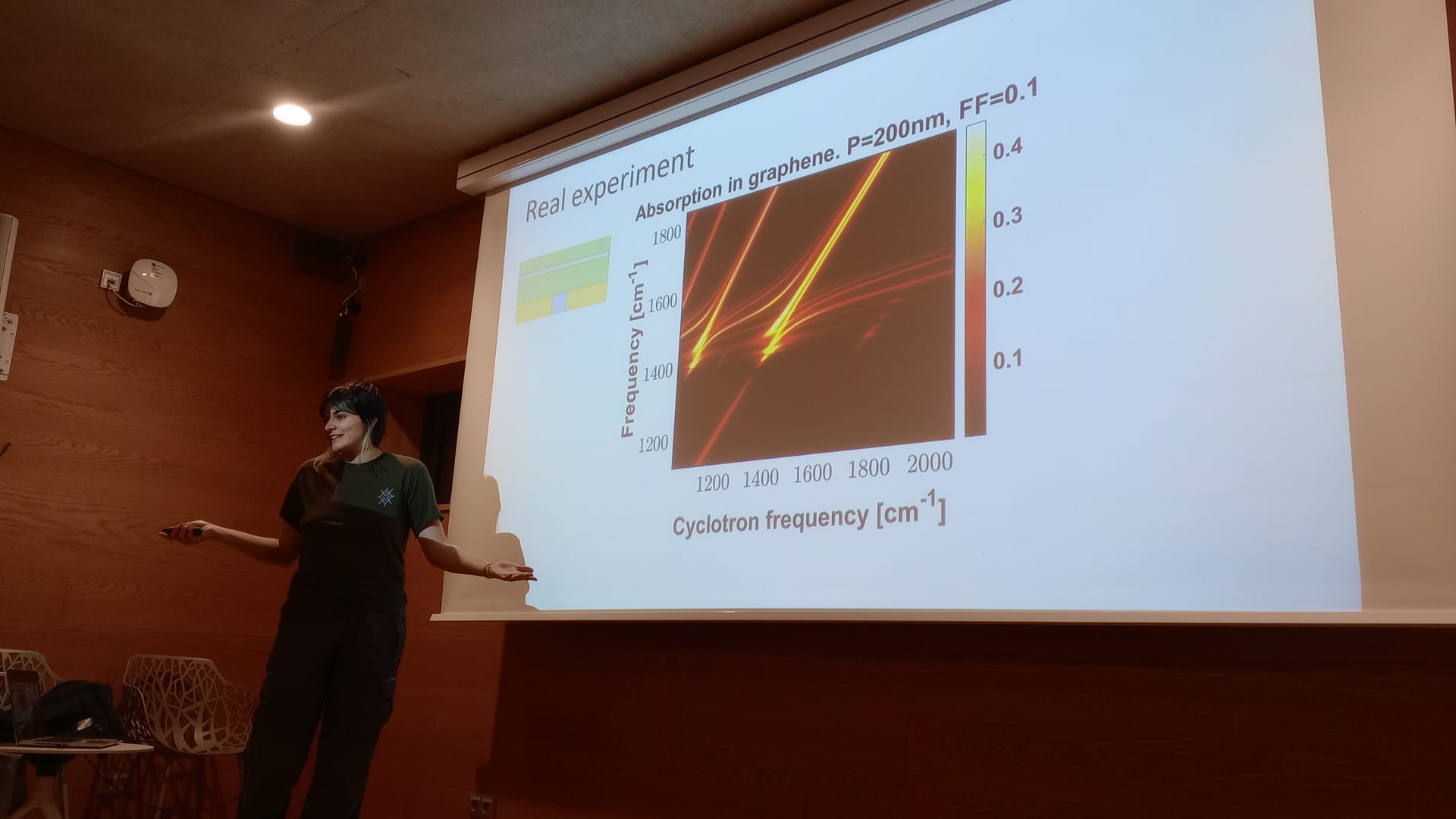
In this talk, we will explore how assembling different vdW crystals gives rise to entirely new materials. The opto-electronic properties of these heterostructures differ strikingly from those of their constituent materials, as interlayer interactions unlock the formation of new electron-hole states with distinct energy, lifetime, spin-valley selection rules, and spatial confinement, thereby affecting light absorption and emission. We will show how the system’s interaction with light can be exploited to reveal the properties of these new electronic configurations.
June 3rd

👤Professor at the Theory of Quantum Matter and Nanophysics group
📍 Technical University of Munich (TUM)
📝 Unconventional quantum phases in correlated materials, e.g. Quantum Spin Liquids, Unconventional Superconductors or Topological Kondo Insulators.
June 18th

July 16th

Quantum simulation
Engineering & understanding quantum systems atom-by-atom
Prof. Dr. Monika Aidelsburger
Max-Planck-Institute of Quantum Optics & Ludwig-Maximilians-Universität München
Delve into how Quantum Simulators can help us study complex phenomena and realize exotic phases of matter in the lab!
Find out more in our Substack



.jpeg)
.jpeg)